
Introduction
Self-confidence is the belief in your own ability to handle challenges and succeed at specific tasks. It isn’t something you’re born with; it’s a skill built through small, repeated actions. Confidence grows with evidence, not perfection.
If you’ve ever frozen up before a presentation, deleted a photo because you second-guessed how you looked, or watched someone else raise their hand while you stayed quiet, you already know what low confidence feels like.
The good news is that self-confidence isn’t a fixed trait you either have or don’t. It’s closer to a muscle: something you can train with the right, repeatable habits.
Understand What Confidence Actually Is?
Before you can build self-confidence, it helps to know what you’re actually building. According to the American Psychological Association, self-confidence is the belief in one’s capability to succeed in specific situations or accomplish particular tasks, and it plays a meaningful role in overall psychological well-being.
Confidence isn’t a permanent personality trait, and it isn’t the same as arrogance. It’s task-specific and buildable. You can feel confident giving a speech but not confident dancing at a party, and that’s completely normal.
Nobody is confident at everything, and expecting yourself to be is one of the fastest ways to feel like you’re failing at confidence when you’re actually just human.
- Confidence is situational, not universal
- It fluctuates based on preparation, experience, and recent feedback
- Feeling nervous doesn’t mean you lack confidence; it means you’re doing something that matters to you
Know the Difference Between Confidence and Self-Esteem
This is one of the most confused pairs in personal development content, and getting it right changes how you approach building either one.
Self-confidence is about your belief in your abilities: can you do the thing?
Self-esteem is about your sense of worth: are you valuable, likable, enough, regardless of what you can or can’t do?
You can have high confidence in your coding skills and still struggle with low self-esteem in relationships. You can have strong self-esteem and still feel nervous about a specific new skill you haven’t mastered yet. Working on both matters, but they respond to different strategies:
- Confidence responds to competence: practice, feedback, and small wins in a specific area
- Self-esteem responds to self-acceptance: how you treat yourself independent of performance
Knowing what you actually lack saves you from chasing the wrong fix.
Start With Radically Small Wins
Most confidence advice jumps straight to “step outside your comfort zone,” which is true but unhelpful if your comfort zone currently feels like a postage stamp. Confidence is built the same way trust is built with another person: through a track record of small, kept promises to yourself.
If you’re starting from a place of real self-doubt, don’t aim for the TED-talk-sized challenge first. Aim for something almost embarrassingly small:
- Speak up once in a group chat or class discussion
- Make eye contact and say hello to one new person
- Finish one task you’ve been avoiding, even a small one
- Post one thing online without deleting and re-editing it five times
Each completed “small win” becomes evidence your brain can point to later. That evidence, not motivation, not a pep talk, is what confidence is actually made of.
Use Your Body Language to Change How You Feel
Confidence isn’t only a mental process; it’s physical. How you hold your body sends signals not just to other people, but back to your own nervous system.
- Stand with your shoulders back and your weight even on both feet, rather than curled inward
- Keep your chin level rather than looking down at your phone or the floor
- Slow your speech down slightly rather than rushing to finish sentences
- Take up a comfortable amount of physical space rather than shrinking
None of this requires you to feel confident first. It’s a “fake it to build it” approach grounded in the idea that internal states and physical posture influence each other in both directions. You don’t need to feel ready to stand like you’re ready.
Rewrite Your Self-Talk
The way you talk to yourself in your head, especially after a mistake, shapes your confidence more than almost anything external. But there’s a difference between useful self-talk and forced positivity that doesn’t hold up under stress.
Instead of:
- “I’m terrible at this.” Try: “I’m new at this, and I’m improving with practice”
- “Everyone probably thinks I’m awkward.Try: “I don’t actually know what they think, and most people are focused on themselves”
- “I always mess this up.” Try: “I messed this up this time — that’s one data point, not a pattern”
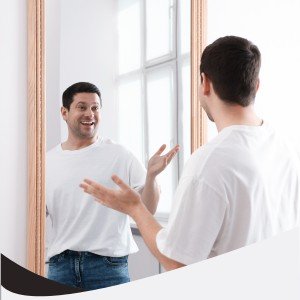
Notice these aren’t hollow affirmations like “I am a superstar.” They’re accurate, slightly kinder reframes, realistic enough that your brain will actually accept them, which matters more than sounding inspirational.
Prepare More Than Feels Necessary
One of the most reliable, least talked-about confidence tools is boring: preparation. Nervousness often isn’t really about the event itself, it’s about uncertainty. The less unknown there is, the less there is to be anxious about.
- Before a presentation, rehearse out loud, not just in your head
- Before a difficult conversation, write out roughly what you want to say
- Before a new social situation, think through one or two questions you could ask
- Before a job interview, research the company and practice answers to common questions
Preparation doesn’t guarantee a perfect outcome, but it shrinks the gap between “I have no idea what will happen” and “I have a plan,” and that gap is where most anxiety lives.
Limit the Comparison Trap on Social Media
For teens and adults alike, one of the biggest modern threats to self-confidence isn’t a bad performance or an awkward interaction, it’s scrolling. Social media compresses everyone’s highlight reel into a single feed, and comparing your ordinary Tuesday to someone else’s curated best moment is a losing game by design.
- Notice when you feel worse after scrolling, and treat that as useful data, not something to ignore
- Mute or unfollow accounts that consistently trigger comparison, even if you “should” like them
- Remember that filters, angles, and selective posting apply to almost everyone’s feed, not just influencers
- Replace passive scrolling with intentional use: messaging a friend, posting your own thing, then logging off
This isn’t about quitting social media. It’s about noticing that comparison is a habit you can interrupt, not a fixed cost of being online.
How Does Social Media Affect Self-Confidence?
Social media can lower self-confidence when it turns into constant social comparison, measuring your unfiltered daily life against other people’s edited highlights. It isn’t the platform itself that causes the harm; it’s the pattern of comparison it makes easy. Being aware of your own scrolling habits and curating your feed intentionally can significantly reduce this effect.
Reframe Failure as Information, Not Identity
Confident people are not people who fail less. They’re people who’ve learned to treat failure as informationabout the task, not a verdict on their identity. That single reframe changes what setbacks do to you.
- Ask “what does this tell me about the task?” instead of “what does this say about me?”
- Separate the outcome from your effort you can prepare well and still not get the result you wanted
- Keep a short, honest log of what you’d do differently next time, and nothing more
- Give yourself the same tone you’d use with a friend who came to you after a setback
This is one of the clearest overlaps between confidence work and general resilience: the goal isn’t to avoid failing, it’s to stop letting each failure cost you more than the failure itself.
Understand and Interrupt Imposter Syndrome
Imposter syndrome is the persistent feeling that you don’t actually deserve your achievements and that you’ll eventually be “found out” as a fraud even when there’s clear evidence you’re capable. It’s extremely common, especially among high-achievers, students starting something new, and people early in a career or creative path.
- Recognize the specific thought pattern: attributing success to luck or timing, and failure to your own inadequacy.
- Keep a simple record of concrete things you’ve actually accomplished, not for bragging, but as evidence you can revisit.
- Talk to peers about it; imposter syndrome tends to shrink the moment you realize how many other people quietly feel it too.
- Separate the feeling of being a fraud from actual evidence that you are one. Feelings aren’t facts.
What Is Imposter Syndrome and How Does It Connect to Confidence?
Imposter syndrome is the internal experience of feeling like a fraud despite genuine evidence of competence, and it directly undermines confidence because it discounts your actual track record. Interrupting it usually involves noticing the pattern, naming it, and deliberately weighing evidence over feelings.
Build Competence Through Deliberate Practice
Confidence built purely on mindset without any real skill underneath it tends to be fragile; it cracks the first time it’s tested. Durable confidence is usually paired with actual competence, built through deliberate, repeated practice rather than talent alone.
- Pick one specific skill area rather than trying to feel confident “in general.”
- Practice in a way that includes feedback, not just repetition, repetition without feedback can just reinforce mistakes.
- Track progress concretely (a portfolio, a log, recordings of yourself) so growth is visible, not just felt.
- Expect a slow start; competence-based confidence compounds; it doesn’t spike overnight.
A meta-analysis on the self-confidence performance relationship found a modest but consistent positive correlation, reinforcing that confidence and skill reinforce each other over time rather than one simply “unlocking” the other.
Set Boundaries and Practice Saying No
Confidence also shows up in how comfortable you are protecting your own time, energy, and decisions. Constantly saying yes out of fear of disappointing others quietly erodes self-trust, because it signals to yourself that other people’s comfort matters more than your own judgment.
- Practice a short, non-apologetic way to decline: “I can’t take that on right now.”
- Notice the urge to over-explain or justify a boundary, and try trimming the explanation down.
- Start with lower-stakes boundaries before tackling harder ones.
- Remember that a reasonable boundary that disappoints someone briefly is not the same as being unkind.
Surround Yourself With People Who Reflect Reality, Not Just Praise
The people closest to you shape your confidence more than almost any solo exercise. This doesn’t mean surrounding yourself only with people who compliment you constantly; unearned praise can actually undermine confidence by making it feel disconnected from anything real.
- Seek people who are honest and supportive, not just agreeable.
- Notice how you feel after spending time with specific people; some relationships consistently drain confidence, others rebuild it.
- Ask for specific, honest feedback rather than only reassurance.
- Distance yourself, where possible, from relationships built on comparison or subtle put-downs.
Research from the University of Melbourne found that people who reported higher confidence earlier in life tended to earn better wages and advance more quickly at work later on, a reminder that the environments and relationships shaping your confidence early can have long, compounding effects.
Difficulty ratings are subjective and based on average audience feedback.
Conclusion
Self-confidence isn’t a personality trait you either got lucky with or missed out on; it’s a skill, built the same way any other skill is: through small, repeated, sometimes uncomfortable practice. Start with one or two of the steps above rather than trying all twelve at once.
Notice your self-talk, your posture, and your social media habits this week, and pick a single small win to aim for. Bookmark this guide and come back to it as you go; confidence tends to build in layers, not overnight.
What is the difference between confidence and self-esteem?
Confidence is belief in your ability to succeed at specific tasks; self-esteem is your overall sense of worth as a person, independent of performance.
Can confidence really be learned, or are some people just born with it?
Confidence is learned and task-specific rather than an inborn, fixed trait. It’s built through repeated small wins, preparation, and evidence you gather about your own capability over time.
Why do I feel confident sometimes but not others?
Confidence is situational, tied to specific skills, recent experiences, and preparation, rather than a single constant trait. Feeling confident in one area and unsure in another is completely normal.
How does social media affect self-confidence?
Social media can lower confidence through constant social comparison between your unfiltered daily life and other people’s curated highlights. Being intentional about what you follow and how you use it can significantly reduce this effect.
What is imposter syndrome and how does it connect to confidence?
Imposter syndrome is the persistent feeling of being a fraud despite real evidence of competence. This undermines confidence by discounting your actual track record. Easing it usually starts with naming the pattern and weighing evidence over feelings.